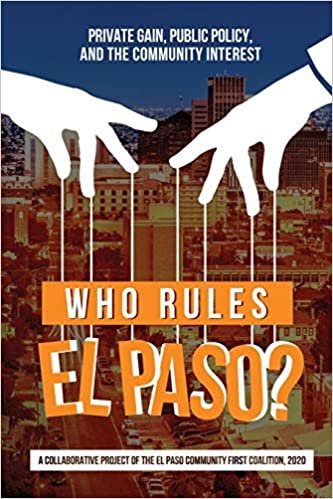
Who Rules El Paso?
By: CFC
Who Rules El Paso? To answer this question, a reader might respond that the mayor and city council representatives rule the city of El Paso. On deeper examination, less visible forces appear to shape many of the representatives’ decisions—like puppeteers pulling the strings. In this evidence-based book with multiple sections, readers can better understand recent historical and current perspectives on developers’ designs for the downtown, political campaign contributions, land deals, the travesty of the University of Texas at El Paso presidential appointment, and case studies of downtown boondoggles past and planned—all within the impending disaster of a heavily indebted city and high property taxes.

LatinX El Paso
By: Oscar J. Martinez
In Latinx El Paso Oscar Martinez provides a historical and contemporary overview of the Mexican American/Hispanic population in one of the major urban centers of the U.S. Southwest Borderlands, El Paso, Texas, where, for centuries, the local way of life has been shaped by intense interaction between Latinos/as and European Americans in a binational environment. The emphasis of the book is on the experience of ordinary people, with significant attention devoted to economic, social, educational, and political disparities between the Mexican American majority population in the city and the non-Hispanic white, or Anglo, minority. While Latinx El Pasoans have made impressive strides in elevating their status over the last half-century, much remains to be done. The group continues to be substantially underrepresented in elite circles, top businesses, and sundry decision-making bodies. This book explains why.
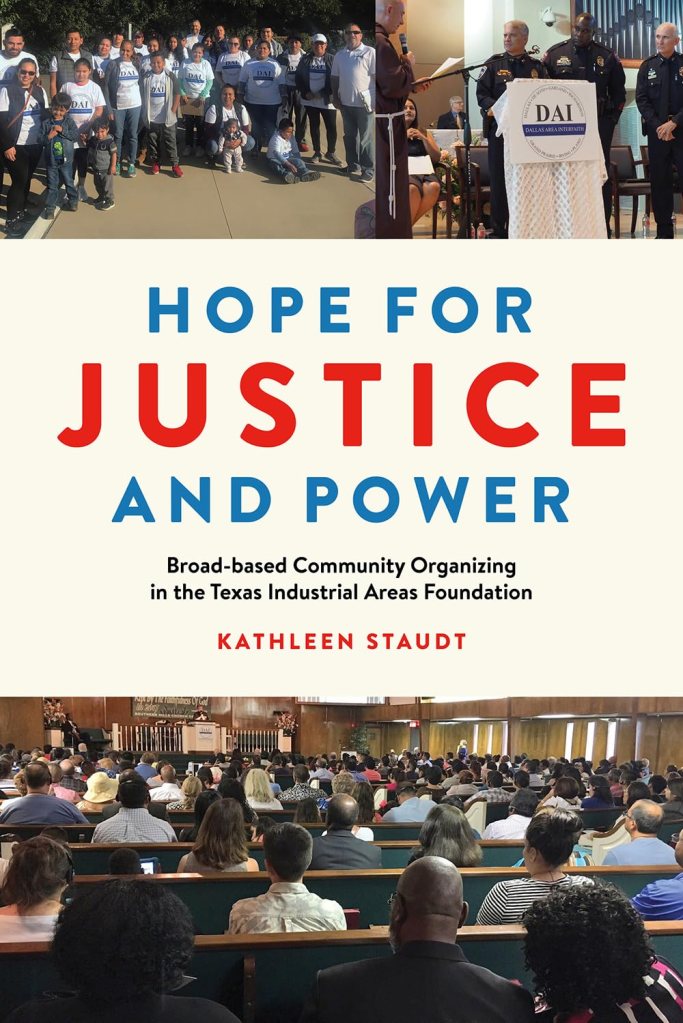
Hope for Justice and Power
By: Kathleen Staudt
Texas-based affiliates in the Industrial Areas Foundation (IAF) offer a strong, mature organizing model compared with other community organizations. In Hope for Justice and Power, Kathleen Staudt examines the twenty-first-century activities of the Texas IAF in multiple cities and towns around the state, drawing on forty years of academic teaching and on twenty years of active leadership experiences in the IAF. She identifies major contradictions, tensions, and their resolutions in IAF organizing related to centralism versus local control, reformist versus radical goals, stable revenue generation, greater gender balance in leadership, and evolving IAF principles.
 Community First Coalition